
A common challenge for the hunched-forward or “kyphotic” posture is weakness in the mid-back and interscapular muscles. Over time, this can lead to rounded shoulders, a forward head, and that all-too-common “upper back hump.”
To properly correct this pattern, you need to retrain the muscles that stabilize your shoulder blades and upper spine.
At our clinic, Transform Chiropractic in Toronto, one of our favorite exercises for this is the neck and scapular retraction exercise, performed lying face down — known as the prone retraction exercise.
Key Insight:
Most rounded-shoulder and forward-head posture patterns don’t start in the neck — they start when the mid-back stabilizers become weak and stop supporting the shoulder blades. Strengthening these deep postural muscles makes it far easier for your neck and head to stay aligned throughout the day.
How the Neck and Scapular Retraction Exercise Helps Posture
This simple prone neck retraction exercise helps you:
Retrain posture alignment by drawing your head and neck back over your shoulders.
Strengthen key stabilizers between your shoulder blades that prevent rounding and slumping.
Ease tension in the neck, shoulders, and mid-back.
It’s a practical way to counteract the daily effects of sitting, screen time, and forward-leaning posture — an easy yet powerful mid-back posture strengthening move you can do at home.
When the upper back becomes stiff or the shoulder blades lose stability, the neck is forced to work overtime to keep your head upright.
This is why so many people with forward head posture also struggle with mid-back fatigue — the two patterns almost always appear together.
If you’re dealing with forward head posture or “tech neck,” here’s our full guide to forward head posture and tech neck for more detail.
Step-by-Step Instructions
Step 1 – Starting Position: Neck Retraction
Lie face down on a supportive surface like a carpet or yoga mat (avoid soft beds that sag).
From this position, gently draw your chin straight back — not backwards into extension — as if creating a double chin. Think chin tuck, not looking up at the sky. Note how the head is not extended back and the eyes are still focusing down.
This is a neck retraction, aligning your head over your shoulders and counteracting forward head posture.
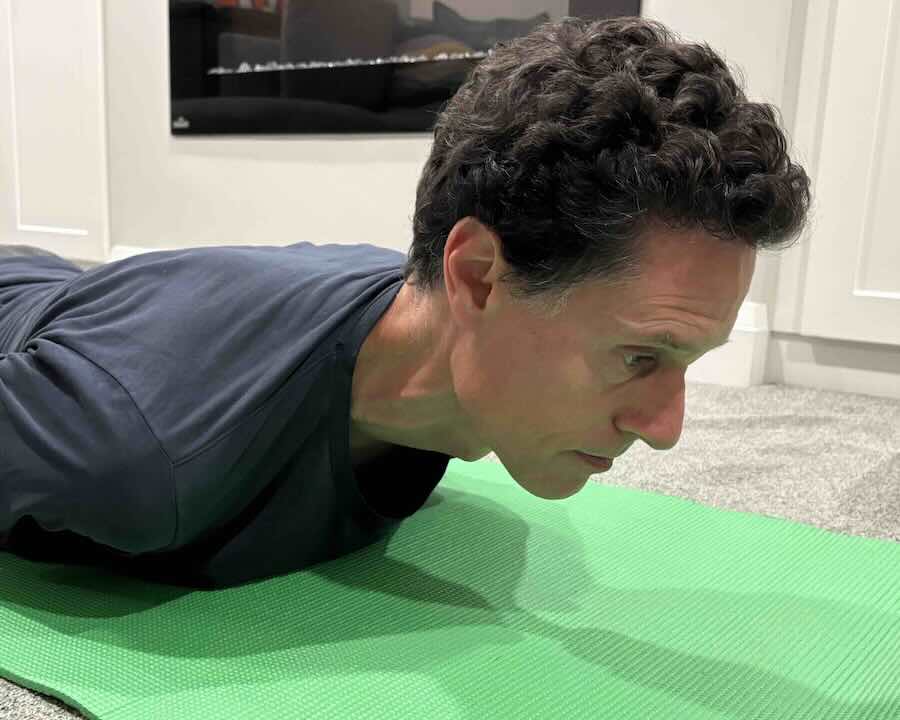
Step 2 – Scapular Retraction for Posture Correction
Place your hands behind your back or by your sides.
Draw your shoulder blades back and slightly down toward your toes.
Lift your shoulders slightly off the floor as you do this — not by pushing with your arms, but by activating the mid-back muscles.
Hold this position for 10–15 seconds, then relax for 5 seconds, letting your body rest on the floor.
Repeat for 10–15 repetitions, ideally twice per day.
You should feel gentle effort in the mid-back and between the shoulder blades — not sharp pain in your neck or back.

Step 3 – Combine Neck and Scapular Retraction for Maximum Effect
Once comfortable, combine both movements:
Retract your chin (neck retraction).
Pull shoulder blades back and down (scapular retraction).
Hold for 10–15 seconds, rest, and repeat.
This movement takes some practice, but over time it strengthens the mid-back “postural” muscles that keep your shoulders open and your head balanced.
Common Mistakes to Avoid During Mid-Back Posture Strengthening
Lifting too high: keep your neck and chest low; focus on muscle engagement, not height.
Tilting your head back: this extends rather than retracts your neck. Keep your gaze down — only your chin is being tucked.
Holding your breath: breathe normally throughout the movement.
Shrugging shoulders up: your goal is down and back, not up toward your ears.
Progressions & Regressions (Make the Exercise Fit Your Level)
If the full version feels too difficult:
Keep your forehead resting on a small folded towel.
Start with just the chin tuck for 5–10 seconds before adding the scapular movement.
Do shorter holds (5 seconds) and build gradually.
If you’re ready to make it more challenging:
Lift your hands slightly off the floor while retracting your shoulder blades.
Add a light 1–2 lb weight in each hand.
Hold the combined position for 20–30 seconds instead of 10–15.
Small increases in tension make the postural stabilizers adapt faster — without straining the neck.
Extra Tips for Success
Practice near a mirror initially to check your neck and shoulder position.
Perform the exercise slowly and deliberately; quality matters more than quantity.
Combine this move with gentle wall angels or the Titanic exercise for even greater scapular stabilization and neck pain relief.
When to Be Cautious
Mild stiffness is normal at first, but sharp pain is not.
If you have acute neck, shoulder, or disc injuries, be very cautious with any new exercise, and modify or discontinue if pain occurs until assessed by a healthcare professional.
If you’re unsure, our team at Transform Chiropractic in Toronto can help evaluate your posture and guide you toward safe variations.
For stubborn posture issues or combined neck + upper back tension, you may also find value in our detailed guide to posture correction in Toronto, which outlines how these postural patterns develop and how we correct them.
FAQs – Neck and Scapular Retraction Exercise
How often should I do this exercise?
Aim for 10–15 reps, 1–2 sets, twice per day — morning and evening work well. Consistency retrains posture faster than intensity.
Will I feel this in my neck or shoulders?
Yes — light effort in both is normal. The goal is gentle activation, not strain.
Can this exercise fix forward head posture?
Absolutely. By strengthening your mid-back and stabilizers, it helps your head and neck stay better aligned.
Strengthening the mid-back makes chin tucks, wall angels, and other posture exercises far more effective because your shoulder girdle can finally support the weight of your head properly.
Is this safe if I have arthritis or a disc issue?
Usually yes, but stay within comfort range. If pain increases, stop and have your spine and posture assessed more thoroughly.
How long until I notice results?
Most people feel more open and upright after 1–2 weeks of steady practice.
What mistakes should I avoid?
Don’t lift too high, extend your neck, or tense your shoulders. Keep it smooth and relaxed.
Final Thoughts on the Neck and Scapular Retraction Exercise
This neck and scapular retraction exercise may look simple, but it’s one of the most effective ways to strengthen your posture and retrain your body’s natural alignment. A few minutes a day can make a real difference.
If you’re unsure about your form — or if this exercise keeps feeling harder than it should — it may be a sign that deeper postural imbalances or restricted spinal motion are at play.
At Transform Chiropractic in Toronto, we assess how your neck, shoulders, and mid-back are working together and tailor your posture plan to your exact alignment. If you’d like guidance or want to ensure you’re doing the exercise correctly, we’re here to help.
Written by Dr. Byron Mackay, Chiropractor – Transform Chiropractic, Toronto
Updated November 2025


